“The plumber was in and out in under two hours. The new tank works great. The old one is still standing in my garage, and it has been there for three weeks.”
Some version of that call reaches Orange Crew constantly once heating season starts. The replacement went fine. Nobody planned for the old tank. It is now a 5-foot steel cylinder parked where the car goes, and every week it stays there it gets easier to ignore. Here is who takes it away, which of those options cost nothing, and what we charge when none of them work out.
Key Takeaways
- Many installers haul the old tank away as part of the job. Ask before you pay the final invoice, not after.
- If the City of Chicago collects your garbage, you must arrange a bulk pick-up with your ward Streets and Sanitation superintendent before setting a large item out.
- Scrappers do take steel tanks from alleys, but it is unpredictable and not something to plan around.
- Orange Crew charges a flat $280 for a water heater or boiler, and the tank must already be drained and disconnected when we arrive.
- An old tank is mostly steel, so it goes to metal recycling rather than straight to a landfill.
Why It Is Still Sitting in Your Garage
Water heaters get replaced in clusters, and fall is the cluster. ENERGY STAR advises that if you suspect your water heater is over 10 years old, it is time to consider replacing it before you are left with an emergency decision. Plenty of Chicagoland homeowners act on that right before winter.
The install is straightforward. The disposal is where it falls apart. The crew that fitted your new tank is a plumbing crew, not a hauling crew: their truck is full of parts, disposal may never have been quoted, and carrying a wet steel tank up basement stairs is not what they were hired for. So it ends up in the garage. Moving it just takes a truck, two people, and somewhere legal to put it, which is the whole premise of appliance removal and of residential junk removal generally.
Free Option 1: Your Installer May Already Owe You the Haul-Away
Start here: it is the option most likely to cost nothing and the one most people skip. Pull up the quote or invoice and look for a line reading “disposal,” “haul away,” or “old unit.” Many plumbing and HVAC companies fold removal into the job price by default, and plenty of the rest will do it for a modest add-on. If that line is there, you already paid for it.
If it is not there, ask anyway. Installers are often back in your area within days, and grabbing a tank whose size and location they already know is easy work. If a balance is still owed, ask before you settle it; the same question lands very differently three weeks later. This applies to furnaces, AC condensers, and softeners too, all of which sit on our list of items we remove when the installer will not.
Free Option 2: Scrap Metal, and Why Some Tanks Vanish
A conventional water heater is a steel shell with copper and brass fittings on top. That is valuable material, which is why tanks set out in Chicago alleys sometimes disappear before any official truck arrives.
Two cautions. This is luck, not a plan: a tank can vanish in an hour or sit for a month, and while it sits it is your responsibility. An unannounced large item in a Chicago alley is also a sanitation violation regardless of who eventually takes it. If you own a pickup and the tank is at ground level, driving it to a metal recycler yourself is a real option, and you may leave with a few dollars instead of a bill.
Free Option 3: What the City Will and Will Not Do
Chicago's rules are specific, and getting them wrong turns a free pickup into a fine. City residential garbage service covers households in single-family homes or apartment buildings of four units or less. Everyone else, including larger apartment buildings and every business, must arrange private collection. And for anything oversized, the Chicago sanitation code is direct about the sequence: arrange a bulk pick-up with your Streets and Sanitation ward superintendent before putting out any large item or extra load of trash. Set the tank out first and ask later, and you have created a violation rather than a pickup.
So if you are in a single-family home or two-flat, can move the tank yourself, and are not in a hurry, the city route is free and legitimate: call your ward office, get on the schedule, then put it out. The suburbs have no single answer: every village runs its own program with its own bulk-item rules and fee system. Barrington does not work like Palatine, which does not work like Evanston. Check your village's refuse page before assuming it is covered.
When You Do Not Need Orange Crew at All
We would rather say this plainly than take money for something you could have had free.
Skip us if your installer will come back for it. Skip us if you are in a Chicago single-family home or small two-to-four flat, can get the tank to the alley, and can wait for the ward pickup. Skip us if a contractor dumpster is already on site for a bigger renovation, because the tank can simply go in it. Skip us if you own a pickup, the tank is at ground level, and a scrap yard is a reasonable drive.
Call us for the rest: the tank is down a basement staircase, you have no truck, the installer is unreachable, you are in a condo the city does not service, or the tank is one of several things that need to disappear at once. That last one is where our junk removal pricing works in your favor.
What We Charge to Take an Old Water Heater

A water heater or boiler is $280 on our published single-item chart. That is a flat number, not a starting point, and it covers the labor to carry it out, loading, hauling, disposal, fuel, and travel. Nothing is waiting at the end.
If the tank is truly the only thing going, $280 is the number. But most garages holding an orphaned water heater hold other unwanted things too, and that is where volume pricing changes the math. Truckload rates run $150 for a 1/8 load, $280 for a 1/4 load, $430 for a half, $550 for three-quarters, and $650 for a full load. Read those two numbers together: a lone water heater is $280, and a quarter-truck holding the tank plus the old shelving, the dead shop vac, and the wrecked patio chairs is also $280. If you have been putting off a garage clear-out, combine it with this trip. Smaller single items start at $120.
Every quote is confirmed before we start. The on-site estimate is free and carries no obligation, so if the number does not work you can decline at no cost. You can also text photos for a quick quote. Orange Crew is locally owned, fully licensed and insured, and holds a 5.0 Google rating, which is worth exactly as much as the crew that shows up acts like it is. For the full sequence, how it works lays it out.
What Has to Happen Before Our Crew Pulls Up
One hard requirement, worth being blunt about: we take tanks that are already drained and disconnected. Our crews are haulers, not licensed plumbers. We do not cut gas lines, break water connections, or disconnect electrical supply, because that work belongs to someone licensed for it.
In almost every case it is already done, because the tank was disconnected when the new one went in. If yours is still hooked up, that is a call to your plumber. If it is disconnected but still full, drain it: shut off the supply, kill the gas control valve or the breaker, run a hose from the drain valve to a floor drain, and open a hot tap upstairs to let it flow.
A drained tank still holds water and sediment, so keep it upright on a flattened box if it is on a finished floor. All we need past that is a clear path to where we can park. Our walkthrough on how to remove an old appliance covers the same prep. When you are ready, book online or grab a free estimate.
Where Your Old Tank Actually Ends Up
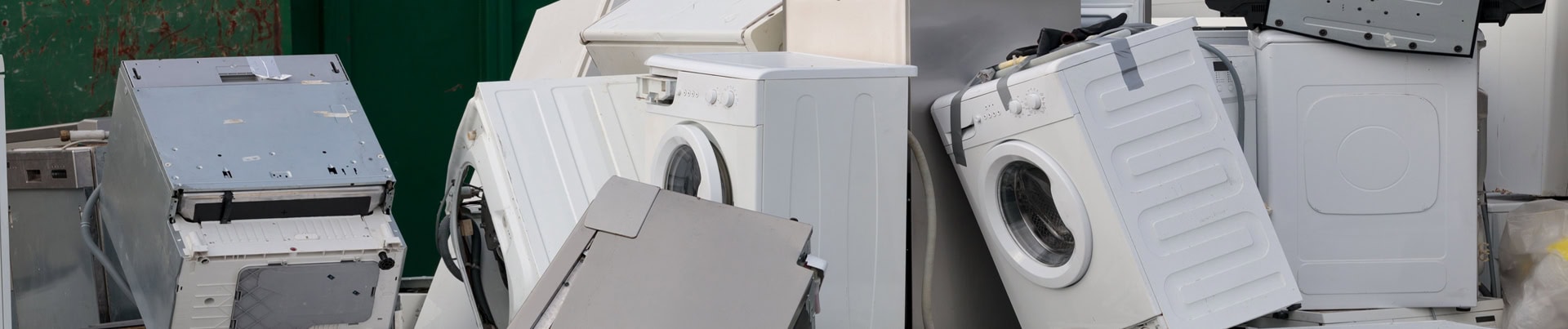
A water heater is one of the better appliances to get rid of: almost all of it is recyclable and none of it is hazardous. The steel shell and the copper and brass fittings go to metal recycling through Chicago-area facilities we already use. Only the insulation and glass lining have nowhere useful to go.
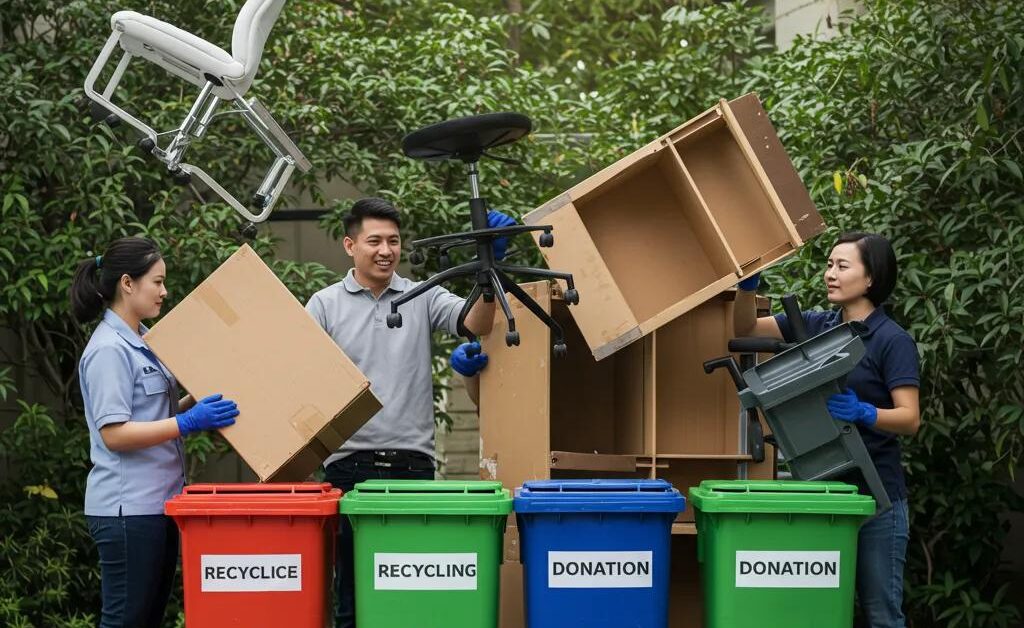
The EPA's appliance disposal rules on refrigerant recovery cover refrigerators, freezers, window air conditioners, and dehumidifiers, all of which hold refrigerant that a certified technician must recover before disposal. A water heater holds none, so it skips that step. If your fall project also involves an old fridge or window AC, that one does need the extra handling. Sorting happens on every job: usable goods go to donation partners, metals go to recyclers, and only what cannot be reused gets disposed of. Recycling receipts are available on request.
Water Heater Removal Across Chicagoland
Orange Crew runs three offices: Chicago and Cook County from W. Peterson Ave, northwest Cook and Barrington from Barrington Commons Ct, and DuPage and the west suburbs from Clarendon Hills. That means pickups across Chicago proper plus Barrington, Palatine, Arlington Heights, Schaumburg, Northbrook, Evanston, Clarendon Hills, Hinsdale, and the towns around them. Same-day and next-day slots are often available. Call (888) 308-7556 and tell us what floor the tank is on.
Before You Call: A 7-Point Checklist
- Check the installer's invoice for a disposal or haul-away line, and call them first.
- If a balance is still owed, ask about the old tank before you pay it.
- Confirm the tank is disconnected from gas or electric and from the water supply.
- Drain it, and leave it standing upright on cardboard or a towel.
- In Chicago, arrange the bulk pick-up with your ward superintendent before the tank goes out; in the suburbs, check your village's rules.
- Walk the path from the tank to the driveway and clear anything in the way.
- Look around the garage and decide whether a 1/4 load at $280 beats a single item at $280.
Frequently Asked Questions
How much does water heater removal cost in Chicago?
Orange Crew charges a flat $280 for a water heater or boiler, covering labor, loading, hauling, disposal, fuel, and travel. If other items go at the same time, a 1/4 truckload is also $280 and a 1/8 load is $150, so combining the tank with a garage clear-out often costs no more than the tank alone.
Do I have to drain and disconnect it first?
Yes. We remove tanks that are already drained and disconnected from gas, electric, and water. Our crews are haulers rather than licensed plumbers, so we do not break gas or water connections. In most cases the installer already disconnected it when the new unit went in.
Will the City of Chicago take my old water heater for free?
Possibly, if the city services your building. Chicago residential collection covers single-family homes and buildings of four units or less; larger buildings and businesses arrange private collection. Even when eligible, you must arrange a bulk pick-up with your ward Streets and Sanitation superintendent before setting the tank out. Suburban villages each set their own rules.
What happens to the tank after you take it?
It goes to metal recycling. The steel shell and the copper and brass fittings are recovered through Chicago-area facilities, and only the insulation and glass lining are disposed of. Unlike refrigerators and air conditioners, a water heater holds no refrigerant, so it needs no special recovery step.